
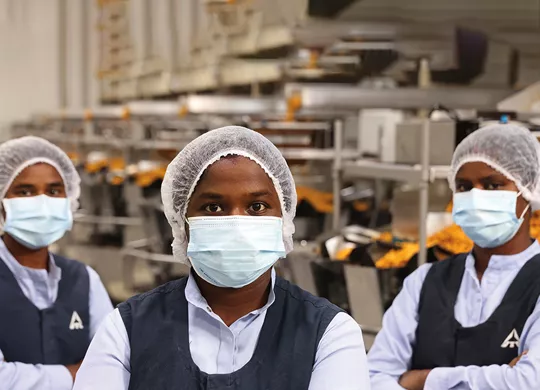
Promoting a Culture of Safety
We believe a safe and healthy work environment is a prerequisite for employee well-being, and the adoption of best practices in occupational health and safety has a direct impact on its overall performance. It helps in attracting and retaining quality talent, besides being the duty of the Company as a responsible corporate citizen.
ITC endeavours to ensure that Environmental, Health, and Safety (EHS) standards at all its units are ahead of legislation, regulations, and codes of practice and are benchmarked against international best practices. ITC's approach to occupational health and safety standards is articulated in the Board-approved EHS Policy. It is based on an EHS management system that emphasises enhancing EHS performance by setting objectives and targets and continually monitoring key performance indicators. Further, it promotes a culture of safety through behaviour change programmes and by providing appropriate training to employees as well as service providers' 'employees, while continually investing in state-of-the-art technology and in developing human capital.
ITC has identified the EHS risk management framework as one of the integral steps towards building a robust safety management system. This framework consists of a set of processes for continual risk identification, assessment, and mitigation with the active participation of the workforce. Digitisation of EHS Management processes has now given additional thrust to their effective implementation. Several national awards and certifications acknowledge ITC's commitment and efforts towards providing a safe and healthy workplace to all.

Safety by Design
From 'Drawing Board' to 'Operations'
ITC follows 'Safety by Design' by integrating best-in-class engineering standards in the design and project execution stages of all investments in the built environment. This helps in reducing potential hazards as well as optimising operational costs. Aspects such as fire safety, electrical safety, material handling, machine safety, people, material flows, etc. are evaluated in detail at the design stage, and the requirements as per best-in-class standards and practices are incorporated. Compliance with these standards is then verified by conducting audits during the project implementation and before the project is formally commissioned.
Safety by Culture
From 'Compliance Focus' to 'Behaviour-Centric' Safety Culture
ITC's journey in safety has evolved from 'compliance driven by standards and guidelines' to a 'behaviour-centric safety culture.'. 'Safety by Culture' looks at driving behavioural changes so that safety is ingrained in the culture of the organisation across operating units. Accordingly, behaviour-based safety initiatives are being implemented across several operating units. To drive the safety culture, ITC is making use of tools such as a structured conversation with workers on 'Safe and Unsafe Acts', supplemented by the adoption of keystone behaviours by individual Units to demonstrate collective commitment and create a shared vision of safety and discipline within the Unit. Design thinking methodologies have also been used to reinforce behavioural based safety initiatives, which have resulted in significant positive changes. In addition, all ITC Units undergo periodic Environmental, Health, and Safety audits at the business level as well as at the Corporate level to verify compliance with standards.
A healthy workforce is an important contributor to ITC's competitiveness and sustainability. All units maintain a conducive work environment in line with Indian and International standards on hygiene, lighting, ventilation, and effective controls on noise and dust. Units are equipped with Occupational Health Centres with adequate medical staff to monitor occupational health and provide immediate relief as required. In addition, at least 2% of total employees are professionally trained as first aid providers. As part of ITC's preventive medical programme, various categories of employees based on age and exposure to occupational hazards undergo periodic medical check-ups. In FY 2023-24, a total of 10,325 employees underwent preventive medical examinations.
Road Ahead
In line with the Company's EHS policy, we will continue to institutionalise safety as a value-led concept by inculcating a sense of ownership at all levels and driving behavioural change, leading to the creation of a cohesive safety culture.
ITC will remain
committed to achieving
the 'Zero Accident' Goal
We will continue to undertake efforts to create a safe working environment and a strong safety culture by:
Integrating safety at the design stage itself and ensuring it through design reviews, stage inspections, and pre-commissioning audits, thereby strengthening engineering control measures through 'design for safety' principles.
Conducting pre-commissioning and periodic operational audits during construction and operational stages respectively.
Progressively covering businesses under various behaviour-based safety initiatives to facilitate engagement for collaborative work on improving safety performances.
Adoption of keystone behaviours by individual units to demonstrate collective commitment and create a shared vision of safety and disciplines.
Leveraging the digital landscape for safety management systems.
The Company will continue to assess its safety performance by tracking both leading and lagging indicators and identifying solutions for strengthening the safety culture accordingly. With this approach, we will endeavour to achieve the organisation-wide goal of "Zero Accidents."