
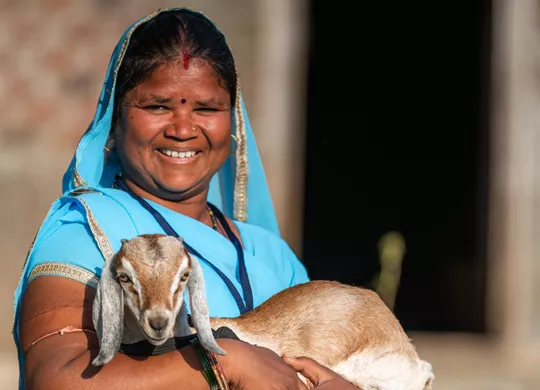
The development journey of any nation is closely interlinked with the empowerment of its women. Women, especially disadvantaged women in rural areas, remain the invisible backbone of society, despite their contribution to households and the economy. Challenges - such as inadequate education, limited opportunities for skills training, inadequate access to financial institutions and restrictive social norms - mean that low-paying labour is often their only option in life.


ITC's Women Empowerment Programme seeks to support women in breaking some of these barriers and in fully realising their potential as catalysts of social change. The Company's approach to women's empowerment goes beyond a single specific intervention; multiple initiatives in play seek to help women realise their entrepreneurial potential through skilling, employment opportunities and participation in community-based institutions.

ITC's Social Development Programme has touched the lives of over 6 million women across its interventions.​


ITC's Women Empowerment Programme


Women are at the core of all of ITC's Social Development Programme. The Programme's two-horizon approach aims to strengthen current livelihoods and build capabilities for the future, for the overall holistic development of marginalised and vulnerable communities - with special focus on women.

Four Pillars of​ ITC's Women Empowerment Programme​
Empowered Grassroots Institutions
Financial Capability Building
Livelihoods & Women Entrepreneurs
Social Security

Together, the four pillars provide a range of gainful entrepreneurial opportunities to underprivileged women. In addition, they are supported by financial assistance in the form of loans and grants, as well as strong market linkages to ensure long-term sustenance.
Economic Empowerment

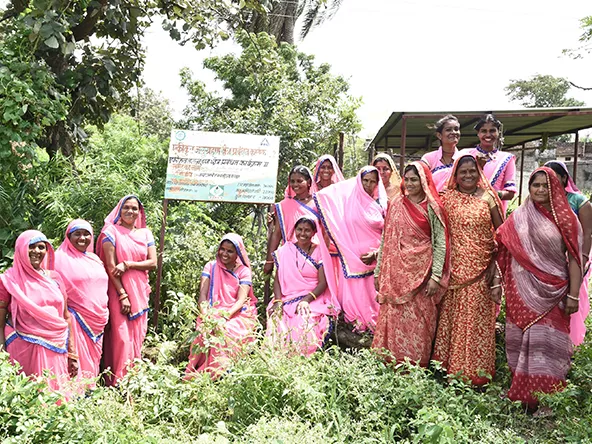
Under this programme, ITC aims to provide women with opportunities to earn independent incomes, helping to strengthen their position as decision-makers in their families and communities.

imagealt
Impact
4,51,000 women beneficiaries till date
Over 9,000 SHGs covering 1,05,000+ women formed till date to link poor women with formal credit

Ultra-Poor Women


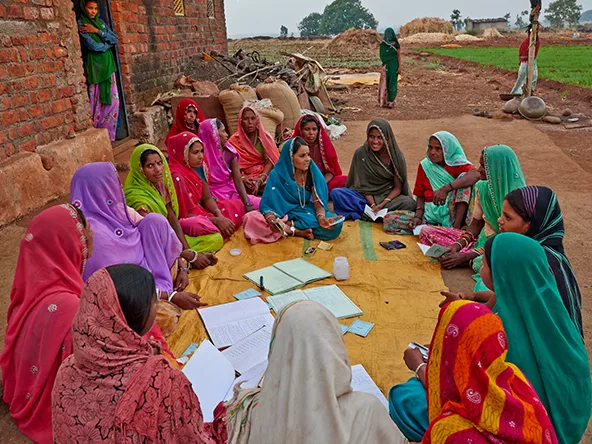
ITC's two-year Ultra-Poor Women Graduation Programme focuses on socio-economic inclusion through entrepreneurship for ultra-poor women-headed families living in extreme poverty, where a woman is the sole earning member.
Impact
Over 40,200 women provided meaningful livelihoods; experienced significant improvement in other development indicators.
Financial Capability Building

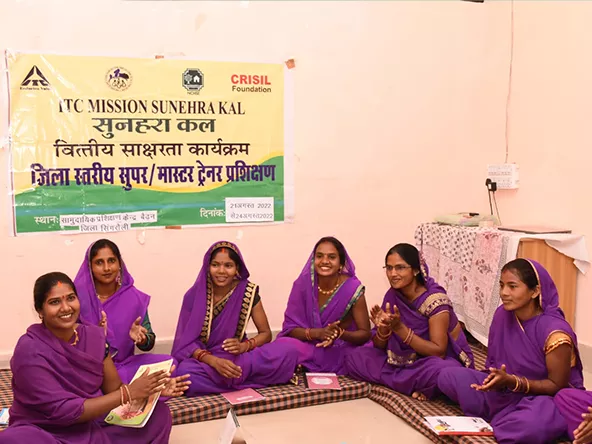
The programme initially started in Madhya Pradesh in partnership with Madhya Pradesh State Rural Livelihood Mission (MPSRLM) resulting in enhanced knowledge of financial planning, linkages to savings, insurance, social security and credit under the partnership. The programme has been extended to 17 states basis the learnings in Madhya Pradesh.

imagealt
Impact
40,20,000+ women benefitted with enhanced linkages to savings, insurance, social security and credit
24,00,000+ trained women provided access to bank accounts and Government social security schemes
Creating Women Entrepreneurs

Promote Women in Agriculture


Women Climate Smart Farmers:


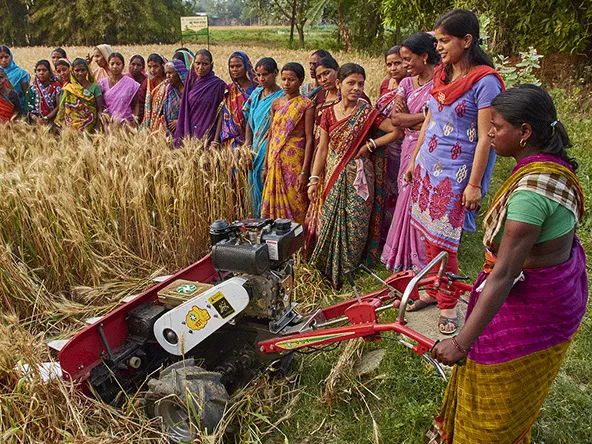
ITC promotes Women Climate Smart Farmers by building their capabilities and helping them in adopting climate smart and standard package of practices for improving yields & income and resilience to climate risks. They are trained through Women Farmer Field Schools which disseminate knowledge, demonstrate sustainable practices and arrange exposure visits enabling the rise of progressive women agriculturists.

imagealt

Women Farmer Collectives:

Women farmer collectives are promoted to take up self-help to members and entrepreneurial activities as a group. Exclusive Women Agri-Business Centres and women Farmer Producer Organisations have enabled rural women to run successful group enterprises like nurseries, agri-equipment hiring, sale of agri-inputs, composting etc.


Women in allied activities:

Women are also encouraged to take the lead in other committees related to agri and allied activities such as Water User Groups and plantation committees (Vannikaran Sanghas), etc.


Impact
755 exclusive Women Farmer Field Schools disseminated scientific and technological best practices to over 1.95 lakh women farmers in 2023.
ITC's Women Farmer Collectives spread across 9 states.

Self-sustaining Cadres or Sakhis

Yojana Sakhis:

ITC trains select women as service providers or 'Yojana Sakhis' to reinforce the supply-side initiatives for its Financial Literacy & Inclusion Project. These trained 'Yojana Sakhis' provide information about government schemes to the community at their doorsteps, help them identify relevant schemes as per their eligibility through mobile-based applications, and assist beneficiaries to enrol in the identified schemes.


Krishi Sakhis:

To encourage the participation of women farmers in agriculture, ITC trains select women as Krishi Sakhis or Master Trainers who promote Climate Smart Agriculture practices.


Pashu Sakhis:

Under its Livestock Programme, ITC promotes a cadre of self-sustaining women service providers or 'Pashu Sakhis' to support goat-rearing women. Pashu Sakhis charge a nominal fee for their services, which not only helps them in earning an additional income but also enables their social upliftment.


Health Sakhis:

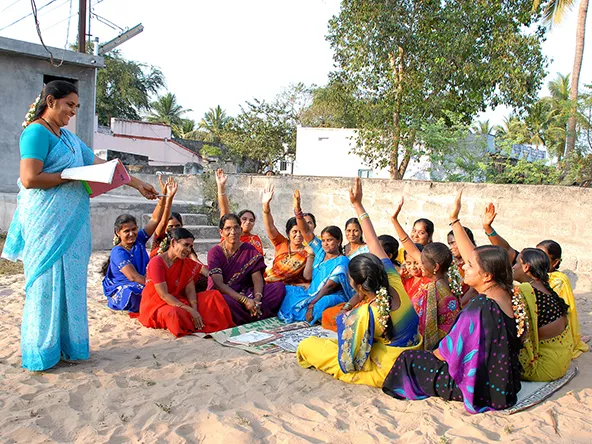
Rural women are trained to become Village Health Champions (VHCs) under this initiative. The VHCs conduct group meetings, school activities and door-to-door visits in their villages, spreading awareness about sanitation, menstrual and personal hygiene, family planning, diarrhoea prevention and nutrition, while providing access to related products and generating a supplementary income for themselves.
Impact
Over 3,050 women have been empowered as Yojana Sakhis, Krishi Sakhis, Pashu Sakhis and Health Sakhis

Outcome
Women gain inclusion and agency in a more equitable community.
Improving Learning Outcome

ITC's Support to Education intervention covers female students in Early Childhood Education & Care and Primary and Secondary education. It provides child-friendly and gender-appropriate infrastructure; activity-based learning; 21st century skills and career intentionality. Moreover, Mothers' Groups were also formed and trained on activity-based learning to reinforce the outcomes. These Mothers' groups helped children at their homes retain the learning levels and bridge learning gaps.

imagealt

ITC is engaged in building the capabilities of anganwadi sevikas on ECCE.


Impact
ITC's education intervention covers over 7.6 lakh girls across 16 states
3,600 Mothers' groups were formed and trained on activity-based learning

ITC's Skilling programmes have trained over 1.22 lakh youth across 16 states, including 50,000 women.
 

Health and Nutrition

Swasthya Choupal


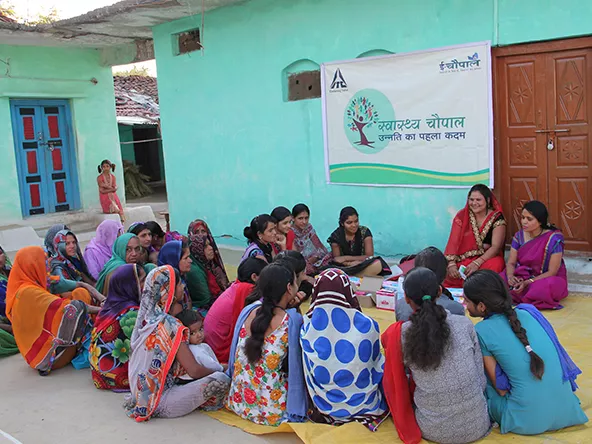
It is a women's health programme, which addresses the lack of access to credible and trustworthy health information, products and services in rural India. The key health issues addressed by this initiative include family planning, diarrhoea prevention and management, menstrual & personal hygiene, sanitation and general nutrition.

imagealt
Impact
366 rural women trained as Village Health Champions reached out to nearly 68,200 women and adolescent girls.
aashirvaad-image

Mother & Child Health Nutrition

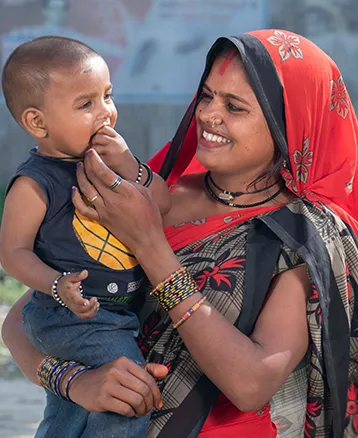
The programme is aimed at improving the health nutrition status of pregnant and lactating mothers, children (up to 5 years), adolescent girls, and eligible couples by creating awareness and strengthening the Government delivery system by following the intensive 1,000-day approach.

ITC's Project Samposhan operational in Uttar Pradesh and Karnataka focuses on women's nutrition in general and anaemia in particular.
 

Impact
Over 15.24 lakh beneficiaries covered under Mother & Child Health Nutrition programme
Collaboration for Change

4 Public-Private Partnerships


Through a PPP with Tribal Cooperative Marketing Development Federation of India (TRIFED) ITC aims to improve the livelihoods of women organic turmeric farmers in Andhra Pradesh and Odisha. In the first season, 3,400 women farmers were trained. Similarly, PPPs were established with the Government of Rajasthan and the State Rural Livelihood Missions of Maharashtra and Bihar to strengthen the livelihoods of women agriculturists.

 ITC’s Climate Smart Agriculture
Targets for 2030


To enhance support to 250,000
women under the Women's Economic
Empowerment Programme


Contribution to India /​ Alignment to National Schemes​
National Rural Livelihoods Mission
Self-Help Groups
Producers' Enterprises
Financial literacy to women
Alignment to SDGs
Our key initiatives

ITC invests in people and practices that are good for the planet. 

image 1
Addressing Climate Change
Building a Climate Positive Organisation​
Supporting Livelihoods
Transforming Lives and Livelihoods​
image2
Renewable Energy
Powering the Transition to Renewable Energy
image 3
Green Buildings
Pioneering Green Buildings​
image4
Circularity
Towards Circularity​
image5
Sustainable Packaging
to address single use plastic substitution with scalable, innovative, and eco-friendly solutions. ​
image6
Climate Smart Agriculture
Empowering Farmers with Climate Smart Agriculture​
image7
Water Stewardship
Integrated Water Stewardship Programme​
image09
Biodiversity Conservation
Preserving Biodiversity for a Sustainable Future​
image10
Afforestation
Enhancing Green Cover, Supporting Livelihoods​
image8
Livestock Development
Creating Off Farm Livelihood Opportunities​
image11
Women Empowerment
Enabling Women to Fulfil their Potential​
image12
Support to Education
Helping Children Improve Quality of Education​
image13
Skilling & Vocational Training
Skilling India's Youth to Build a Future-Ready Workforce​
Healtcare
Healthcare
Improving Preventive Healthcare, Augmenting Curative Services​
image14
Sustainable Supply Chain
Building a Resilient & Sustainable Supply Chain​
brand with purpose
Brands with Purpose
Driving Change through Purpose-led Brands​
image15
Occupational Health & Safety
Fostering Health and Safety at Workplace​
image16
Talent
Creating a Workforce for Tomorrow​
Diversity, Equity and Inclusion
Creating a Diverse, Equitable and Inclusive Culture​
image17
Human Rights
ITC has a long-standing commitment to Human Rights, which is reflected in its Code of Conduct for its employees, Suppliers', and Service Providers'. ​
Corporate Social Responsibility
Generating livelihoods & environmental capital​
ITC CSR Policy
ITC CSR Policy
Corporate Social Responsibility Policy​
ITC Social Investments Impact Studies
ITC's Social Investments Programme under Mission Sunehra Kal​
RPF's For Impact Assessment & Other Studies
Request for Proposal of Impact Assessment of Projects undertaken by ITC’s Social Investments Programme across India