
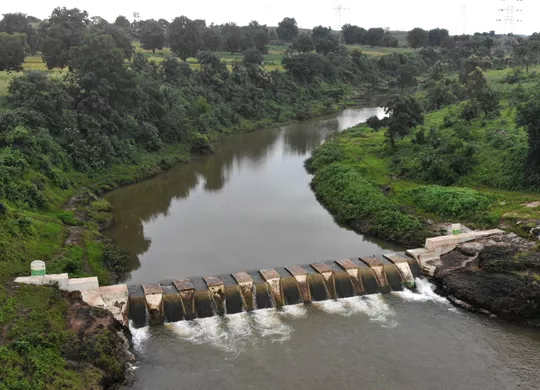
Water is a precious natural resource. It is fundamental for agriculture, energy, ecosystems, and indeed human survival. Water plays a central role in adaptation to climate change, linking societies and the environment. With climate patterns shifting, populations rising and cities expanding, India's vulnerability to water scarcity is becoming increasingly severe. Given that half of the country is facing water stress, there is a pressing need for collective efforts to implement effective water management practices.
At ITC, we recognise the critical importance of water as a lifeline for growth and progress. ITC's businesses are largely dependent on agriculture and forestry for key raw materials, where water is a critical resource. We recognise that replenishing water resources is crucial, more so in stressed areas, and vital for sustenance of agriculture that drives the rural economy and impacts lives and livelihood. In addition, there is also dependence on water for our operations. We have therefore spearheaded a multi-dimensional water stewardship programme, that focuses on a three-fold approach.
To guide our efforts, we have adopted a multidimensional approach for conducting water risk assessments and prioritising our actions effectively.
ITC is Water Positive for 24 years

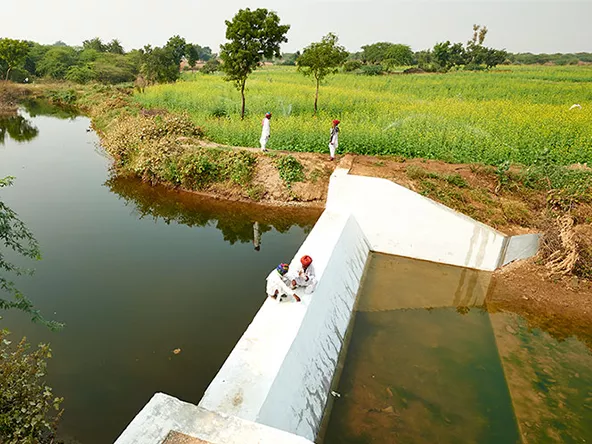
Community-led management
Community participation is at the heart of our Integrated Watershed Development Programme. We have established Water User Groups (WUGs) as grassroots institutions, bringing communities together to manage their local water resources collaboratively through public-private-people partnerships.
We support small and marginal farmers in forming these groups, providing them with the tools and knowledge needed to take ownership of water management. These WUGs mobilise community action, ensuring sustainable use of local water resources. Through hands-on training and capacity-building, ITC helps farmers make informed decisions, securing water for agriculture.
Structures constructed and revived include farm ponds, rock-filled and gabion dams, irrigation and percolation tanks, check-dams and stop dams.
Revival of Traditional Structures
We are also committed to blending the wisdom of tradition with the innovation of modernity. Significant efforts have been undertaken to revive and restore indigenous water conservation systems, ensuring that age-old practices are harmoniously integrated with contemporary approaches for sustainable water management.
Impact
With water available for irrigation and improved soil fertility, farmers are less dependent on rainfall and can grow more than one crop a year, of better quantity and quality - thus, significantly improving their income and quality of life.
Rainwater Harvesting in Factories
A key part of ITC's water stewardship approach involves adopting sustainable practices within our operations as much as possible. All our units implement action plans to work towards maximising rainwater harvesting through use of technology and advanced processes, audits and international benchmarking. Within our operations, ITC's efforts include constructing recharge pits, collection tanks, filtration units for reducing dependence on fresh/ground water.
Outcome
Annual rainwater harvesting potential created within ITC factories till date - 1 million kl
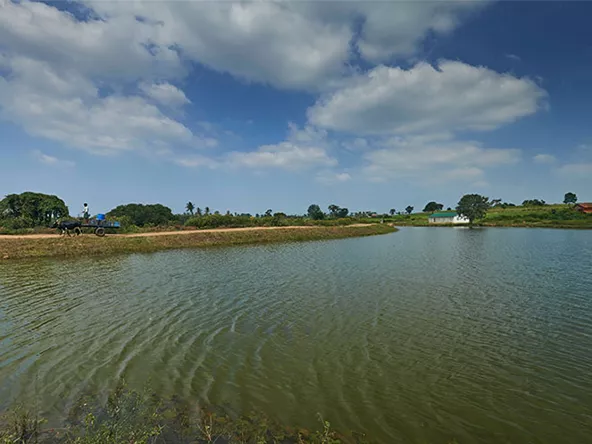
More crop per drop practices to promote water efficiency at scale:
Direct seeding of rice
Alternative wetting and drying
Drip -irrigation
Wider spacing
Zero tillage
Broad-bed furrow
Trash mulching
Collaboration
ITC collaborates with knowledge partners like the Indian Council of Agricultural Research (ICAR) and the International Water Management Institution (IWMI) to demonstrate water-efficient practices to farmers.
Scaling up:
Farmers are encouraged to adopt and scale practices across crops. In addition, they receive assistance to leverage government schemes for equipment and micro-irrigation subsidies.
Impact:
ITC's strategy of demand management of water in agriculture has led to significant water savings, lower cultivation costs, and increase in overall agricultural productivity and farm incomes.
Maximising Water Use Efficiency within Operations
All ITC units work towards reducing net water consumption and achieving zero effluent discharge through use of technology and advanced processes, audits and international benchmarking.
ITC's efforts include:
Water Audits and Assessments
Water Security Assessments: An integral Part of Greenfield/ Brown Field Projects
Recycling and Reusing Water in Operations
Industry 4.0 Initiatives (Advanced ML for Predictive Analysis) for Driving Efficiency
ITC has adopted the Alliance for Water Stewardship (AWS) framework to ensure water security for all stakeholders at the catchment level and monitor the efficacy of its water stewardship programmes. Till date, 9 out of 13 AWS Platinum certified sites in India belong to ITC.
ITC Hotels are at the forefront of water conservation. The first five hotels in the world to receive the LEED® Zero Water certification by US Green Building Council are ITC hotels.

ITC is working on reviving such river basins with negative water balance, thereby securing value-chains and serving communities. The Ghod river basin in Maharashtra, faced a post-monsoon water deficit. To enhance availability of water in this region, ITC carried out several interventions. We commissioned hydrogeological studies to estimate the water balance and identify high-potential recharge zones. Based on the findings, we implemented rainwater harvesting, managed aquifer recharge, and measures to reduce water demand in agriculture, particularly for sugarcane and onion cultivation. These efforts collectively contributed to the Ghod River becoming water positive and led to a 21% improvement in downstream water. Our interventions enabled the Ghod River basin to become water positive in five years, achieving this milestone in 2021. The success has led ITC to pursue similar projects in Tamil Nadu, Telangana, Karnataka and Madhya Pradesh.
Projects
River Ghod in Maharashtra
River Kolans in Madhya Pradesh
River Upper Bhawani in Tamil Nadu
River Murreru in Telangana,
River South Pennar in Karnataka
River Ghod Basin in Maharashtra covers major industrial zones including ITC factories
Water Deficit Prior to ITC's interventions: 62 Million kL
Surplus Created Through ITC's Interventions: 152 Million kL
Urban Water Management Initiative
Recognising the escalating water stress in urban areas, we have also implemented urban water management programmes in several places including Kovai, Bengaluru and Tiruvottiyur, where our units are located. These programmes aim to address key challenges such as flash floods, depleting groundwater levels and water shortages. Our initiatives focus on:
Reviving urban water bodies
Improving drainage systems
Implementing roof water harvesting
Recharging groundwater, including shallow aquifers
Developing models for water treatment and recycling for agricultural use
Kovai Case Study
ITC's Paper Mill is situated in Kovai obtains its water from a stream prone to water security risks due to erratic climatic conditions, excessive water usage, and rapidly declining ground water levels. ITC in association with WWF India in 2015, a detailed assessment was undertaken to identify its annual water deficit. Next, a comprehensive water stewardship plan was prepared and implemented.
ITC Kovai became the 2nd facility in the world and 1st in India to be awarded the Alliance for Water Stewardship (AWS) Platinum-level certification in 2019-20
Collaboration for Change
49 Public-Private Partnerships in Water Stewardship
Alignment to SDGs


